Plant sweet corn 1 to 2 weeks after your last frost, 10 inches apart in rows 30 inches apart, and harvest in 60 to 95 days. Sow 1 to 2 inches deep and always in a block of at least four rows, never a single row — corn is wind-pollinated and a row gives ears with missing kernels.
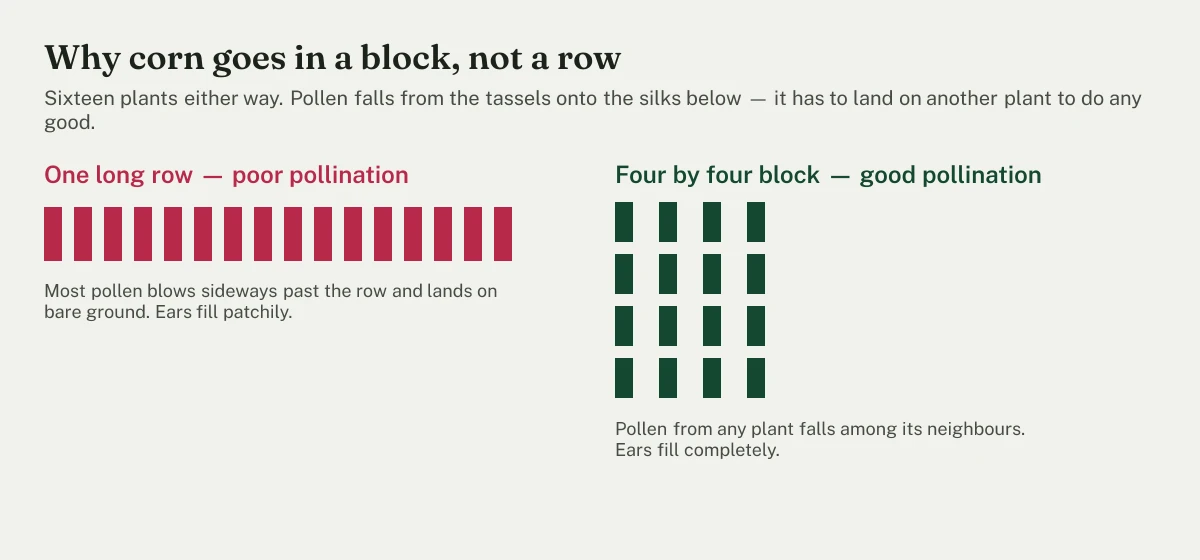
Plant in a block, not a row
This is the single most important thing on the page, and it is why so many first corn crops produce disappointing ears.
Corn is wind-pollinated. The tassel at the top of the plant sheds pollen, which falls onto the silks emerging from the developing ears below. Every silk that catches a pollen grain becomes one kernel. A silk that catches nothing leaves a gap.
In a single long row, most pollen blows sideways and away. The plants at the downwind end get some; much of it lands on bare ground. The result is the familiar ear with kernels scattered across it like a bad chessboard.
Plant a block at least four rows deep instead — four by four is a sensible minimum for a home garden, and more is better. Pollen shed from any plant then lands among its neighbours. A short, wide block beats a long, narrow one every time, even with the same number of plants.
If you have only room for a few plants, hand-pollinating is a real option: shake the tassels over the silks on a dry morning when pollen is shedding.
Sweet corn companion plants
Good neighbours, and why.
Beans are the classic partner and one of the few with mechanisms in both directions. Climbing beans use corn stalks as support, and legumes fix nitrogen, which a heavy-feeding crop like corn appreciates — though most of that nitrogen becomes available after the beans break down rather than during the season.
Squash completes the Three Sisters. Its broad leaves shade the ground between corn stalks, suppressing weeds and holding moisture, and the prickly stems are said to deter raccoons. The shading effect is genuine; the raccoon claim is folklore.
Cucumbers and watermelons work on the same principle as squash, occupying ground level under a tall crop — watermelon in particular appreciates the light shade and wind protection a corn block provides. Sunflowers attract pollinators and predatory insects, though they compete for light if planted too close.
Bad neighbours, and why.
Tomatoes. Two arguments, both reasonable. They are both heavy nitrogen feeders competing directly, and corn's height shades a tomato badly. They also share a pest: the corn earworm and the tomato fruitworm are the same insect, so growing both together supports a larger population of it.
Whether companion planting actually works sorts the mechanisms above from the folklore.
Spacing and sowing depth
10 inches between plants, 30 inches between rows, arranged as a block.
Sow 1 to 2 inches deep — the shallower end in cool spring soil, the deeper end in warm or dry conditions. Corn needs firm contact with moist soil to germinate evenly, and a shallow sowing into ground that then dries out gives a patchy stand. Deeper than two inches and the seedling uses too much of its reserve reaching the light.
The plant spacing calculator will work out how many plants a given block holds.
When to plant
1 to 2 weeks after your last frost, and only once the soil has warmed. Corn is frost-tender and germinates badly in cold ground.
Soil temperature is the condition that matters. Above about 60°F, corn sprouts in 7 to 10 days. Below it, germination stretches to three weeks or more and a large proportion of the seed simply rots. Sowing early to gain a week routinely loses two.
Supersweet varieties are fussier still and want warmer soil than standard sweet corn. The planting date calculator gives the frost-relative date; check the soil alongside it.
Successional sowing every two to three weeks extends a harvest that is otherwise uncomfortably concentrated — a block of corn tends to be ready all at once.
Growing in containers
Possible, and rarely satisfying. Corn is tall, wind-pollinated and a heavy feeder, so it wants a block rather than a pot.
If you try it, use a large container — at least 12 inches deep — and grow several plants grouped together rather than one per pot, so pollination has a chance. Expect smaller ears than open ground.
Watering and feeding
Corn is thirsty and a heavy feeder. Water about an inch a week, and more during tasselling and silking, which is the critical window — drought stress then directly costs you kernels.
Nitrogen matters here in a way it does not for most crops. Corn is one of the few garden vegetables that genuinely responds to a generous nitrogen supply, and a side-dressing when the plants are knee-high pays off. How to add nitrogen to soil covers the sources and how fast each releases.
Do not remove the side shoots at the base. The old advice to strip them is wrong; they contribute to the plant and removing them wounds it.
Harvest
60 to 95 days, and the window is short — a few days at best.
Three signals together: the silks have turned brown and dry, the ear feels full and rounded through the husk, and a kernel pierced with a thumbnail releases milky liquid. Clear liquid means it is too early; doughy means too late.
Pick immediately before cooking. Sweet corn converts sugar to starch within hours of picking, and that conversion is the entire difference between home-grown and shop-bought.
Common problems
Ears with missing kernels. Poor pollination, almost always from planting in a row rather than a block. Not correctable once the ear has formed.
Patchy germination. Cold soil, or sowing too shallow into ground that dried out.
Corn earworm in the ear tip. Common and usually confined to the top inch or two, which can simply be cut off. A few drops of oil on the silks after pollination reduces it.
Plants blown over. Corn is top-heavy. Earthing up soil around the base as the plants grow encourages prop roots and helps considerably.
Corn grows well with beans and squash in the traditional grouping, and should be kept away from tomatoes.