How to add nitrogen to soil
By Muzamil Ali · Last updated
Blood meal at 12% nitrogen feeds a crop within a month; feather meal at 11-15% can take a year. How to add nitrogen to soil, and which source suits when.
The fastest way to add nitrogen is a rapid-release material: dry fish powder is 12% nitrogen and releases in under a month. The slow route is a legume cover crop or a slow material such as feather meal, which is richer at 11–15% but can take a year. Pick by timing, not by percentage.
How to tell if your soil is short of nitrogen
The pattern of yellowing is the tell, and it is more reliable than the yellowing itself.
Nitrogen is mobile inside a plant. When there is not enough to go round, the plant dismantles it out of old tissue and moves it to new growth, because that is where it does the most good. So the lowest and oldest leaves go pale and then yellow first, while the growing tip stays green. The yellowing is usually uniform across the leaf rather than patchy, and it spreads upward as the shortage continues. Growth is slow and the whole plant looks thin.
That pattern is what separates nitrogen shortage from the other things that turn leaves yellow. Yellowing that starts at the top of the plant points at an immobile nutrient, because the plant cannot move those out of old leaves. Yellowing between the veins while the veins stay green is a different signature again. Yellowing after a week of rain on heavy ground is often waterlogging rather than any shortage at all.
A soil test settles it, and is worth doing before spending money on a fix. Nitrogen is the nutrient a test reports least usefully, because it moves and changes form quickly, but a test tells you about pH and the other nutrients — and a plant that cannot take up what is already there will not be fixed by adding more.
Organic nitrogen sources, and how fast each one works
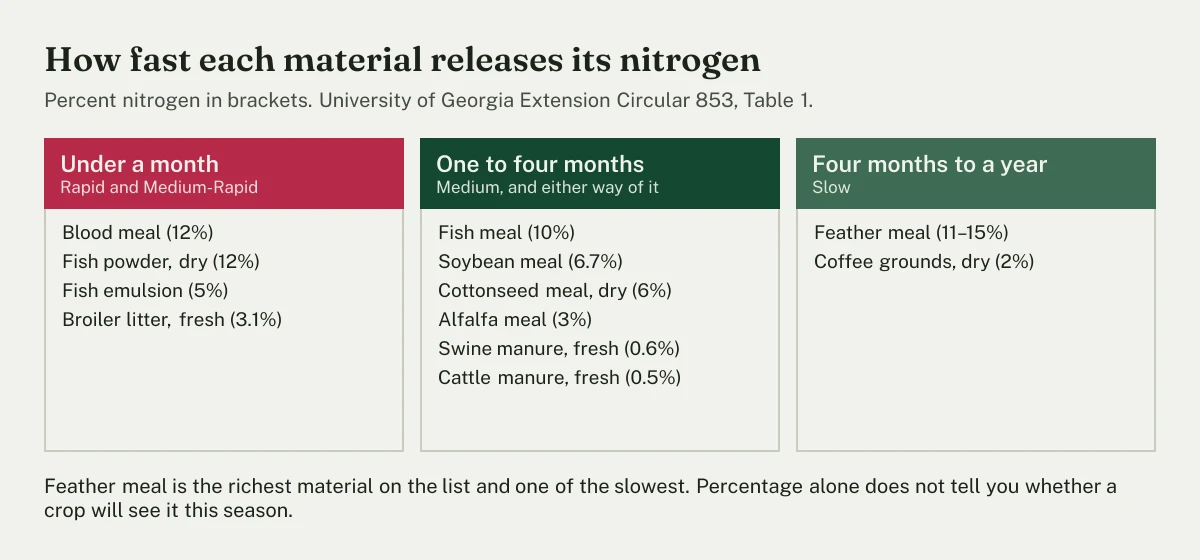
These are the figures from Table 1 of University of Georgia Extension Circular 853, How to Convert an Inorganic Fertilizer Recommendation to an Organic One (Reeves, Gaskin, Kissel, Boyhan, McLaurin and Harris, 15 September 2014). The release rating is the circular's own, and it matters as much as the percentage.
| Material | Nitrogen | How fast it releases |
|---|---|---|
| Feather meal | 11–15% | Slow |
| Blood meal | 12% | Medium-Rapid |
| Fish powder, dry | 12% | Rapid |
| Fish meal | 10% | Slow-Medium |
| Soybean meal | 6.7% | Medium-Slow |
| Cottonseed meal, dry | 6% | Slow-Medium |
| Fish emulsion | 5% | Medium-Rapid |
| Broiler litter, fresh | 3.1% | Medium-Rapid |
| Alfalfa meal | 3% | Medium-Slow |
| Coffee grounds, dry | 2% | Slow |
| Swine manure, fresh | 0.6% | Medium |
| Cattle manure, fresh | 0.5% | Medium |
Release ratings are the circular’s own: Rapid is less than 1 month; Medium is 1 to 4 months; Slow is 4 months to 1 year; Very Slow is more than 1 year. A hyphenated rating such as Slow-Medium falls between the two.
On the manures — broiler litter, fresh, swine manure, fresh, cattle manure, fresh — the circular adds a caveat that has to travel with the figure: Plant nutrients available during the year of application vary with the amount of straw or bedding present and with the method of storage. A manure percentage is a starting point, not a rate.
Three things fall out of that table that are worth saying plainly.
The richest is not the fastest. Feather meal is the highest-nitrogen material on the list and one of the slowest to release. If a crop is hungry now, feather meal will not fix it this month. If you are building fertility for a bed you will plant in spring, that slowness is a feature.
Manures are weak, and variable. Fresh cattle manure is 0.5% nitrogen and fresh swine manure 0.6% — roughly a twentieth of blood meal. Broiler litter is stronger at 3.1%. But the circular's own footnote is the important part: what is actually available in the year you apply it varies with how much straw or bedding is in the load and how it was stored. That is why a manure figure is a starting point rather than a rate.
Liquids are about distribution, not strength. Fish emulsion is 5% nitrogen and rated Medium-Rapid. Its advantage over a dry meal of similar strength is that it goes on evenly and reaches roots immediately, which suits containers and seedlings. It is not more powerful for being liquid.
To turn a percentage into an amount for a specific bed, the fertilizer calculator does the arithmetic from the analysis on the bag. If the three numbers on that bag are not obvious, the guide to what N-P-K actually means covers how they are defined and why the middle one is not what most people think.
Synthetic nitrogen, and when it makes sense
Synthetic fertilizers carry a guaranteed analysis printed on the bag — a legal declaration of content rather than a measurement anyone took. Urea is sold as 46-0-0 and ammonium sulfate as 21-0-0, meaning 46% and 21% nitrogen by weight.
They make sense in three situations. When a crop is visibly short and needs feeding this week. When you need a precisely known amount, because the analysis is guaranteed in a way a manure never is. And when cost per unit of nitrogen matters, which it does at lawn scale far more than at bed scale.
The risk is burning. Concentrated soluble nitrogen draws water out of roots and foliage when applied too heavily or onto wet leaves, and the damage — scorched leaf edges, dead patches — shows within days. The rule that keeps you out of trouble is the University of Connecticut's per-application limit below: never more than 1 pound of water-soluble nitrogen per 1,000 square feet at one time, whatever the product and whatever the annual total.
Organic and synthetic are not a moral choice here. A meal releases slowly and feeds soil biology as it goes; a soluble salt acts immediately and does not. Which one you want depends on whether the problem is this week's crop or next year's soil.
Cover crops: the slow, nearly free method
Legumes — clovers, vetch, field peas, beans — host bacteria in root nodules that convert nitrogen gas from the air into a form plants can use. The bacteria get sugars, the plant gets nitrogen, and when the crop is cut down and left to break down, the soil gets it.
The part that decides whether this is useful to you is timing. This is an autumn-to-spring commitment, not a fix for a hungry plant this week. You sow in late summer or autumn into a bed that has finished cropping, the crop grows through the cool months, and you cut it down and turn it in or leave it as a mulch a few weeks before planting in spring. The nitrogen becomes available as the residue decomposes, which takes those few weeks — sow and plant on the same day and you get nothing.
It is nearly free, it costs you nothing but seed and a bed that would otherwise sit bare, and it improves structure and suppresses winter weeds at the same time. It is simply on a different clock from everything else in this article.
Nitrogen for lawns
Lawn advice is quoted per 1,000 square feet, which is not how vegetable-bed advice is usually given — bed advice tends to come per plant, per row foot, or per bed. Mixing the two up is how people end up applying a bed rate across a lawn or vice versa, so check which unit a recommendation is in before acting on it.
For cool-season grasses — Kentucky bluegrass, the fescues and perennial ryegrass — University of Connecticut Extension's Suggested Fertilizer Practices for Lawns (Dawn Pettinelli, 2001, revised 2015) gives about 2 pounds of nitrogen per 1,000 square feet per year for satisfactory growth if you leave the clippings in place, or 3 pounds if you remove them.
The difference between those two figures is the clippings. Grass clippings left on the lawn decompose and return their nitrogen, which is worth a full pound per 1,000 square feet per year — a third of the requirement, for the work of not bagging them.
The limit is separate from the annual total and is not a suggestion: never apply more than 1 pound of water-soluble nitrogen per 1,000 square feet at one time. An annual programme is split into several applications for this reason, not to be thorough.
What does not work
Coffee grounds as a nitrogen fertilizer. This one deserves better than the usual debunking, because grounds are not inert. Georgia's table credits dry grounds with 2% nitrogen — real, measurable nitrogen. The problem is twofold: the same table rates them Slow, which it defines as four months to a year, and 2% is dilute. To supply what a bed wants you would need a volume of grounds no household produces, and it would arrive long after the crop needed it. Grounds are a genuinely good compost green, and the compost ratio calculator will show where they sit in a mix. As a fertilizer for a hungry plant, they are the wrong tool.
Epsom salt. It is magnesium sulfate. It supplies magnesium and sulfur and no nitrogen at all, so whatever else it may do, it cannot help with a nitrogen shortage. If a plant is yellowing from the bottom up, Epsom salt is not the answer.
Wood mulch, as a nitrogen source. Fresh wood chips do not add usable nitrogen in the short term — their decomposition consumes it rather than releasing it. The surface is also not where that decision gets made: mulch works on top of the soil, and nitrogen availability is a root zone question. The interaction between carbon-rich material and nitrogen is the same one behind a compost heap that will not break down.
Adding nitrogen because leaves are yellow, without checking the pattern. Yellowing from the top, between the veins, or after waterlogging is not a nitrogen shortage, and feeding it wastes money and can make things worse.
Too much nitrogen is its own problem
Over-application is not a neutral error.
Leaves at the expense of crop. Nitrogen drives vegetative growth. A tomato given too much makes a large dark-green plant and disappointing fruit, because the plant is investing in foliage rather than flowering. The same applies to peppers, squash and anything else grown for what it produces rather than what it looks like.
Soft growth invites trouble. Rapid nitrogen-driven growth produces thin-walled, sappy tissue that aphids find easier to feed on and fungal disease finds easier to enter. A heavily fed plant often has more pest pressure than a moderately fed one beside it.
What is not taken up, leaves. Nitrate is soluble and does not bind to soil particles, so nitrogen the crop does not use washes below the root zone or runs off the surface. That is money applied and lost, and it is the reason lawn programmes are split into several small applications rather than one large one.
Common questions
What is the fastest way to add nitrogen to soil? A rapid-release material — dry fish powder at 12% and Rapid, or blood meal at 12% and Medium-Rapid. Fish emulsion at 5% is the usual liquid, chosen for even distribution rather than strength.
Do coffee grounds add nitrogen to soil? They contain 2% nitrogen but release it over four months to a year, so the volume required and the delay both defeat the purpose. Compost them instead.
What is a natural source of nitrogen for plants? Seed and animal meals are the concentrated ones — blood meal 12%, fish meal 10%, soybean meal 6.7%, alfalfa meal 3%. Manures are much weaker and vary with bedding and storage. Legume cover crops need no bag at all.
How do I know if my soil needs nitrogen? The oldest, lowest leaves yellow first while new growth stays green. Yellowing that starts at the top or between the veins is something else.
Can too much nitrogen hurt plants? Yes — leaf at the expense of fruit, soft growth that attracts pests and disease, and leaching or runoff of what is not used.