How much is a yard of dirt?
By Muzamil Ali · Last updated
A yard of dirt is 27 cubic feet and covers about 108 square feet at three inches deep. What a cubic yard looks like, how far it goes, and bags versus bulk.
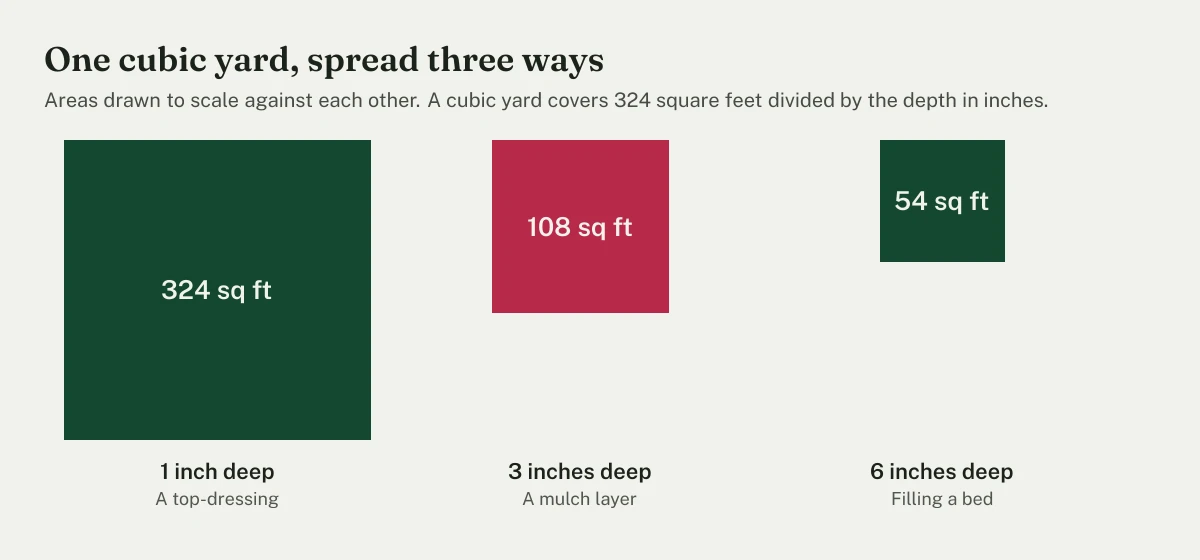
A yard of dirt is a cubic yard — 27 cubic feet, a cube three feet on each side. Spread three inches deep it covers about 108 square feet, roughly a 10 by 10 foot patch. At one inch it covers 324 square feet; at six inches, 54. Depth is what decides how far it goes.
How big is a cubic yard, really?
A cubic yard is a cube three feet on every side. Three by three by three is 27 cubic feet, and that is a definition rather than a measurement — it is exact, and it is the same everywhere.
The number that surprises people is how much space that occupies. Picture a box a little shorter than an average adult, and as deep and as wide as it is tall. Dumped on a driveway it makes a heap roughly the size of a small car. A wheelbarrow holds around 3 cubic feet when full, so a cubic yard is about nine full barrow loads — which is the comparison that usually lands, because anyone who has moved one barrow load knows what nine feels like.
It is also why bulk and bagged soil feel like such different purchases. A cubic yard delivered loose is a single heap you have to move. The same volume in bags is a pallet of individually liftable units, at a price that reflects the packaging.
How much area does a cubic yard cover?
This is the question most people actually mean, and it has a clean answer.
A cubic yard covers 324 square feet divided by the depth in inches.
The derivation is short. One inch is a twelfth of a foot, so spreading 27 cubic feet one inch deep covers 27 ÷ (1/12) = 324 square feet. Spread it twice as deep and it covers half as much. Every figure below follows by dividing 324 by the depth.
| Depth | Area one cubic yard covers |
|---|---|
| 1 inch | 324 sq ft |
| 2 inches | 162 sq ft |
| 3 inches | 108 sq ft |
| 4 inches | 81 sq ft |
| 6 inches | 54 sq ft |
| 12 inches | 27 sq ft |
For a depth not on that list, divide 324 by the depth in inches. Five inches gives 64.8 square feet; eight gives 40.5. The relationship is exact at every depth, because it is arithmetic rather than a rule of thumb.
Reading it the other way round is just as useful. If you know the area you want to cover and the depth you want, multiply them and divide by 324 to get the yards. A 200 square foot border at three inches needs 200 × 3 ÷ 324 = 1.85 cubic yards, so two.
How many bags of soil make a yard?
A cubic yard is 27 cubic feet, so the bag count depends entirely on the size of the bag.
| Bag size | Bags per cubic yard |
|---|---|
| 0.75 cu ft | 36 |
| 1 cu ft | 27 |
| 1.5 cu ft | 18 |
| 2 cu ft | 14 (13.5 rounded up) |
This is where orders go wrong. Bag sizes are not standardised, and two bags of what looks like the same product can hold different volumes — 0.75, 1, 1.5, 2 and 3 cubic foot bags all exist, and potting mixes are frequently labelled in dry quarts rather than cubic feet at all. Counting bags without reading the cubic feet on the label is how people end up with half the material they needed, or a third more than they wanted.
Check the volume printed on the bag, then divide 27 by it. If the label is in quarts or litres, the soil volume converter will put it into cubic feet first.
Working out how much topsoil you need
The method is the same whatever you are filling.
- Measure length and width in feet, and decide the depth in inches.
- Multiply length × width × depth to get cubic-foot-inches.
- Divide by 12 to get cubic feet, or divide by 324 to get cubic yards directly.
A bed 4 feet by 8 feet filled 10 inches deep is 4 × 8 × 10 ÷ 12 = 26.7 cubic feet, which is just under a cubic yard. A 300 square foot lawn area top-dressed at half an inch is 300 × 0.5 ÷ 324 = 0.46 cubic yards, so half a yard.
For anything with a shape more complicated than a rectangle, or when you want the answer split into bags and bulk at once, the raised bed soil calculator does it from your own measurements. What goes into that volume — how much of it should be topsoil rather than compost — is a separate question, covered in what to fill raised garden beds with.
Bulk or bags: how to work out which is cheaper
People searching "how much is a yard of dirt" often mean the price, and the honest answer is that there is no national figure worth quoting. Bulk soil prices vary by region, by material, by supplier and by season, and any number printed here would be wrong for most readers and out of date for all of them within a year.
What does not go out of date is the method. Three steps:
Work out the bagged price per cubic foot. Take the price of the bag and divide by the cubic feet printed on it. A bag is a small, known quantity, so this is easy and it is the figure worth carrying in your head when you are standing in the aisle.
Work out the bulk price per cubic foot. Take the price per cubic yard and divide by 27. This is the comparison most people never make, and it is usually startling — bulk is very often a small fraction of the bagged rate for the same material.
Add delivery to the bulk side. This is where the comparison actually turns. Bulk soil is cheap and delivery is not, and a delivery charge spread across half a yard makes bulk expensive, while the same charge spread across four yards makes it cheap. Many suppliers also have a minimum order, which can decide the question before price does.
The crossover point differs for everyone, which is exactly why the method is more useful than a number. As a shape of the answer: small jobs favour bags because you buy only what you need and carry it yourself, and large jobs favour bulk because the delivery charge stops mattering.
Will a yard of dirt fit in a pickup truck?
By volume, usually. A full-size pickup bed holds roughly two to two and a half cubic yards level with the sides, and a smaller truck around one and a half — but you do not have to take that on trust, because a truck bed is a box anyone can measure. Multiply its length, width and depth in feet, then divide by 27. A bed 6 feet by 5 feet, loaded 1 foot deep, is 6 × 5 × 1 ÷ 27 = 1.1 cubic yards. Measure to the height you would actually load to rather than the top of the sides.
Volume is rarely what decides it. Loose soil is heavy, and what limits a truck is its payload rating rather than its bed capacity — you will reach the weight the vehicle is designed to carry long before you run out of room. Check the payload figure for your specific vehicle before you fill it, and if a supplier is loading for you, tell them what you are driving.
The same applies to the drive home. A load within the payload rating still changes how a vehicle brakes and corners.
What does not work
Assuming a "yard" means a square yard. In landscaping, a yard always means a cubic yard — a volume, not an area. Ordering by the square yard is a conversation that ends in confusion at the supplier.
Ordering the exact calculated figure. Soil settles, spreads unevenly, and some of it ends up somewhere other than where you meant. Rounding up to the next sensible unit costs less than a second delivery.
Counting bags without reading the label. Covered above, and it is the most common error on this page's subject.
Treating bulk soil as interchangeable between suppliers. "Topsoil" is a category rather than a recipe, and two loads can differ visibly in texture and organic matter. Ask to see a sample before a large order.
Common questions
How many cubic feet are in a yard? Twenty-seven — a cube three feet on each side. It is a definition, so it is exact everywhere.
How much area does a yard of soil cover at three inches? About 108 square feet, roughly 10 by 10. The rule is 324 divided by the depth in inches.
How many bags of soil equal a yard? 36 bags at 0.75 cubic feet, 27 at one, 18 at 1.5, or 14 at two cubic feet. Read the label rather than assuming a standard size.
Will a yard of dirt fit in a pickup truck? By volume, usually — a full-size bed holds two to two and a half yards. Payload rather than volume is what normally decides, so check what your vehicle is rated to carry.