Garden soil vs potting soil vs topsoil: which to use
By Muzamil Ali · Last updated
Garden soil vs potting soil comes down to one thing: soil-less mixes drain in a pot, garden soil compacts. Six products compared, and where each belongs.
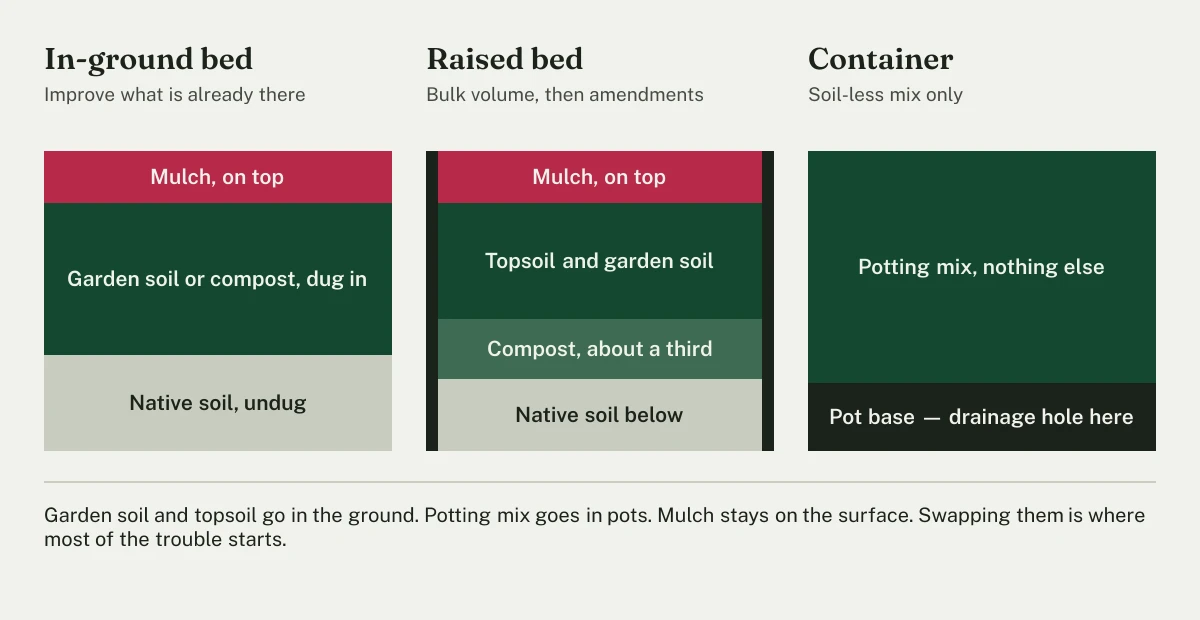
Garden soil goes in the ground and potting mix goes in pots, and the two are not interchangeable. Garden soil compacts inside a container until water sits on top instead of draining; potting mix costs several times as much per cubic foot and slumps in a deep bed. Topsoil is cheaper again, and is bulk filler rather than a growing medium.
The six products, compared
| Product | What it is made from | Use it for | Do not use it for | Cost |
|---|---|---|---|---|
| Topsoil | Screened mineral soil, low organic matter | Filling, levelling, bulk volume in beds | Containers; growing on its own | $ |
| Garden soil | Topsoil blended with compost or bark, sometimes fertiliser | In-ground beds, borders, bulk of a raised bed mix | Pots and window boxes | $$ |
| Potting soil | Peat or coir, bark, perlite — sometimes with real soil | Established container plants | Seed starting, if it contains soil | $$$ |
| Potting mix | Peat or coir, bark, perlite — no soil at all | Every container, and all seed starting | Filling a raised bed, on cost | $$$ |
| Compost | Decomposed plant and animal matter | Amending beds, a third of a raised bed mix | Filling a bed on its own | $$ |
| Mulch | Bark, wood chips, straw, leaves | A surface layer on beds and paths | Digging in; growing directly in | $ |
Cost is per cubic foot and relative, not absolute — bagged anything costs more than the same material delivered loose.
What is topsoil?
Topsoil is the mineral layer scraped from the surface of a site, screened to remove stones and roots, and sold by volume. That is the whole specification. It is not a recipe, and two deliveries from different suppliers can be visibly different in colour, texture and how much organic matter they carry.
What it is good at is volume — filling a hollow, levelling a lawn before seeding, or providing the mineral bulk of a raised bed. Bagged topsoil is convenient; bulk topsoil is dramatically cheaper once you are past about a cubic yard.
What it is not is a growing medium on its own. Screened topsoil is usually low in organic matter and carries no guarantee of fertility. Plants grow in it, but not well, until compost is mixed in.
What is garden soil?
Garden soil is topsoil that a manufacturer has already amended — typically with compost, aged bark or peat, and often a starter fertiliser. It is the in-ground product: beds, borders, and the bulk of a raised bed when combined with compost.
The important limitation is on the bag, and most people read past it. Bagged garden soil says for in-ground use, and that is not marketing. The blend is built for soil that has worms, roots, freeze-thaw and rain keeping it open. None of that happens inside a pot.
Garden soil is also where the "vs topsoil" question usually resolves on price. If you need bulk volume and will be mixing in your own compost anyway, topsoil is cheaper for the same result. If you want to open a bag and plant, garden soil has done that work for you.
Potting soil vs potting mix: the distinction that matters
This is the pair that confuses people most, and it is the one worth getting right.
Potting mix is soil-less. It contains no field soil at all — it is peat moss or coir for water retention, bark or composted forest products for structure, and perlite or vermiculite for air. Potting soil may contain real soil, blended in with those same ingredients.
Four things follow from that one difference:
Drainage. A container has no water table and no soil profile beneath it to pull water down. Water leaves a pot only by evaporating, being used by the plant, or running out of the hole. A soil-less mix has large pores that let it drain and refill with air; add mineral soil and those pores fill with fine particles.
Weight. Soil-less mix is light, which matters for hanging baskets, balcony containers and anything you intend to move. Mineral soil is several times heavier for the same volume.
Sterility. A soil-less mix carries no weed seed and no soil-borne disease. That is close to irrelevant for a tomato in a big pot and close to decisive for a seed tray, where damping-off can take out a whole sowing overnight.
The practical rule: for seed starting, use a soil-less mix and check the ingredients rather than the product name. Manufacturers use "potting soil" and "potting mix" more or less interchangeably on the front of the bag, so the ingredient list is the only reliable guide. Working out how much of it you need for a given pot is what the potting soil calculator is for, and note that bagged mix is sold in dry quarts rather than cubic feet — a difference covered in how much potting soil a container needs.
Compost is an amendment, not a growing medium
Compost is decomposed organic matter. It is the most useful thing you can add to almost any bed, and it is not something to fill a bed with.
A bed of pure compost fails in three predictable ways. It holds water like a sponge and stays wet in the middle. It has no mineral fraction, so it has no structure to hold itself open. And it keeps decomposing after you have filled the bed, so the level drops, sometimes by a third in the first season.
The fix is a mineral bulk with compost mixed through it rather than layered on. The proportions and the arithmetic for a specific bed are set out in what to fill raised garden beds with, and the raised bed soil calculator will split a total volume into those components for you. There is no reason to repeat that case here.
Against topsoil, compost is not better or worse — it is the other half. Topsoil brings mineral bulk and stability; compost brings fertility, biology and water-holding. A bed built from one without the other underperforms.
Mulch vs compost: same family, different job
Mulch and compost are often the same material at different stages, and the difference is entirely about where it goes.
Compost goes in. It is finished, broken down, and mixed into the root zone where it feeds plants and improves structure.
Mulch stays on top. It is coarse and undecomposed — bark, wood chips, straw, shredded leaves — and its job is the surface: suppressing weeds, holding moisture, moderating soil temperature and stopping rain from capping bare ground. It breaks down slowly from the bottom, which is how it feeds the soil, and that slowness is the point.
Composted mulch is a third thing. It is bark or wood that has been partly composted before bagging: darker, finer and more stable than fresh mulch, so it lasts less long on the surface but is less likely to tie up nitrogen where it touches the soil. It sits between the two and can be used either way, at a price above plain mulch.
The mistake worth naming: digging fresh wood mulch into a bed. Undecomposed wood has a very high carbon-to-nitrogen ratio, and soil microbes breaking it down take nitrogen from the surrounding soil to do it, leaving less for the plants. On the surface that effect is confined to the top inch or so and is not a problem. Mixed through the root zone it is.
Can you use garden soil in containers?
No, and the reasons are structural rather than a matter of preference.
It compacts. In the ground, garden soil is kept open by roots, worms, freeze-thaw and rainfall. A pot has none of those. Within a few waterings, a pot of garden soil settles into a dense block that roots struggle to push through.
It drains badly. Compaction closes the large pores that let water through and air back in. A pot's only outlet is the drainage hole, so water sits in the lower half — the zone where roots would otherwise be most active — and roots in saturated soil suffocate.
It is heavy. Mineral soil is several times the weight of a soil-less mix at the same volume. A large planter of garden soil can be immovable, and on a balcony it can exceed what the structure is meant to carry.
If a pot of garden soil is not thriving, repot into a soil-less mix rather than amending what is there.
Can you use potting soil in a raised bed?
You can. It will grow things. It is still the wrong choice, for two reasons.
Cost. This is the big one. A raised bed holds an order of magnitude more volume than a container, and bagged potting mix is the most expensive way to buy volume there is. Filling a 4×8 foot bed to a workable depth with bagged mix costs several times what the same volume of bulk topsoil and compost costs.
Structure. A deep bed of peat-based mix holds a great deal of water, and as the peat fraction breaks down over a season or two the level drops noticeably. Mineral soil does not do that — it is what gives a bed stability over years.
The honest comparison is not potting mix versus nothing, but potting mix versus a proper raised bed mix of topsoil and compost, which costs less, holds its level and grows better. Use bagged mix in a bed only where it sits on a hard surface, is shallow, and is effectively a very large container.
What does not work
Buying by the front of the bag. "Premium", "professional" and "organic" are not specifications. The ingredient list and the intended use line are.
Filling a raised bed with pure compost because it looks rich. It slumps, waterlogs and has no structure. Covered above, and in more detail in the raised bed article.
Putting gravel or crocks in the bottom of a pot for drainage. A coarse layer under a fine one raises the level at which water sits rather than lowering it, because water will not cross the boundary until the material above is saturated. A drainage hole and a mix that drains is all a pot needs.
Digging fresh mulch into a bed. It ties up nitrogen in the root zone. Leave it on the surface, where the same material does only good.
Re-using last year's potting mix for seedlings. It has lost structure and may carry disease from whatever grew in it. Fine topped up with fresh mix for established plants; a poor bet for a seed tray.
Assuming topsoil is consistent. It is a category, not a recipe, so it is worth seeing a sample before a bulk delivery.
Common questions
Is topsoil the same as garden soil? No. Topsoil is screened mineral soil sold for filling and levelling; garden soil is topsoil a manufacturer has already blended with compost or bark. Topsoil is the cheaper route to bulk volume, garden soil has the amendment work done for you.
Can I use potting soil in a raised bed? You can, but it is expensive for the volume and slumps as the peat fraction decomposes. Topsoil and compost is cheaper, holds its level and grows better.
Can I use garden soil in pots? No — it compacts, drains badly with nowhere for water to go, and is very heavy. The bag usually says "for in-ground use" for exactly these reasons.
What is the difference between potting soil and potting mix? Potting soil may contain real soil; potting mix is soil-less. The soil-less one drains better, weighs less and carries no weed seed or disease. Read the ingredients, not the product name.
Is compost better than topsoil? Neither — they are halves of the same answer. Compost brings fertility but shrinks and holds water; topsoil brings mineral bulk and structure. A good bed mixes both.