How to raise soil pH
By Muzamil Ali · Last updated
Raise soil pH with ground limestone and expect three to six months. Sandy soil needs about 25 lb per 1,000 sq ft per pH unit, clay closer to 95.
Raise soil pH with ground limestone, and expect three to six months before the full change shows. A one-unit rise takes roughly 25 lb per 1,000 square feet on sandy soil and closer to 95 lb on clay. Test first — most gardens need less than people assume.
Test before you lime
This is not a matter of good practice. It is a matter of what a mistake costs.
Lime applied on a guess is money spent and a season committed, and you will not know whether it worked until you test anyway. Worse, the error is asymmetric: undershooting is easy to correct and overshooting is not. Add too little and you add more next season. Push a soil too far the other way and you have to bring it back down with elemental sulfur over another several months — which is a separate job with its own arithmetic, covered in how much sulfur to lower soil pH.
A test also tells you something texture cannot: buffer pH. Ordinary pH tells you where the soil sits now. Buffer pH tells you how hard it will resist being moved, which is what actually decides the rate. Two soils reading pH 5.5 can need very different amounts of lime.
How much lime you need
The honest answer is that it depends on your soil, and mostly on its texture and buffer pH.
Clay resists a pH change far harder than sand does, because it holds many more exchange sites that have to be satisfied before the soil solution shifts. University of Kentucky's figures put a one-unit rise at about 25 lb of ground limestone per 1,000 square feet on sandy soil and about 95 lb on clay — close to four times as much for the same distance travelled. Loam sits between them.
Those are starting points rather than prescriptions, and the published ranges behind them are wide. The lime calculator applies the same texture logic to your own bed size and pH gap, shows the range rather than a single figure, and splits the total when it exceeds what should go down at once.
Types of lime, and which to buy
Calcitic versus dolomitic is a magnesium question. Both are carbonates and both raise pH. Dolomitic lime also supplies magnesium, which makes it the right choice where a soil test shows magnesium is low and the wrong one where magnesium is already high. Absent a test saying otherwise, calcitic is the safer default — adding magnesium a soil does not need can interfere with calcium and potassium uptake.
Pelletized versus powdered is a handling question, not a chemistry one. Pellets are powdered limestone bound into granules that break apart when wet. They spread evenly, do not blow around and do not coat you in dust; powdered lime is cheaper and works slightly faster because the particles are already separated. Both end up as the same material in the soil.
Hydrated lime is a different substance — calcium hydroxide rather than carbonate. It is caustic enough to burn skin and eyes, acts far faster than ground limestone, and is very easy to overshoot with. It has real uses in agriculture and in construction. For almost every home garden it is the wrong choice, and the speed that makes it tempting is exactly what makes it dangerous in a bed you cannot easily correct.
When to apply lime
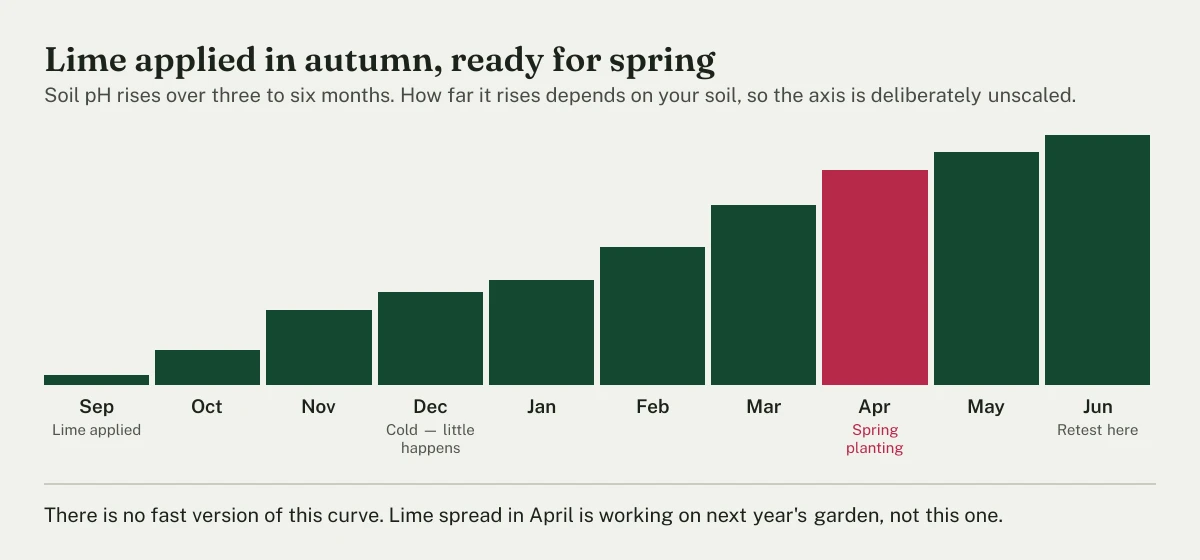
Autumn, for a garden you will plant in spring. This is the single most useful piece of timing on the page, and it is why September is a better month to read this than March.
Lime needs time and moisture to react, and autumn supplies both. Winter rain carries it into contact with soil particles, and freeze-thaw cycles help work it in. By the time you are planting in spring, several months of that has already happened. Apply in April instead and the reaction is only beginning as the crop goes in.
The practical consequence is worth stating plainly: lime spread in spring is working on next year's garden, not this one. That is not a reason to skip it, only a reason not to expect it to rescue a bed you are planting this weekend.
How to apply it
Work it in. This is the same point as the contact one below, and it is worth acting on first: raking or digging lime into the top six inches puts it where the roots are. Left on the surface of an undug bed it can take years to get there.
Spread it evenly. Patchy application gives patchy pH, which is worse than a uniformly slightly-low reading. Split the quantity in half and make two passes at right angles.
Split a large correction. Penn State advises that no single application to turf exceed 100 lb per 1,000 square feet, splitting anything larger into two or more applications four to six months apart — in practice, spring and autumn. Colorado State is stricter on established turf, at 50 lb.
Wear a mask. Even ordinary ground limestone is a fine dust that is unpleasant to breathe.
Keep it away from nitrogen. Leave several weeks between liming and applying ammonium fertilizer or fresh manure. At high pH, ammonium converts to ammonia gas and escapes, so lime and nitrogen applied together means losing a good part of the nitrogen to the air — you have paid for both and get the benefit of one. Phosphate and potash are unaffected, and what the three numbers on fertilizer mean covers which form of nitrogen you are actually holding.
How long does lime take to work?
Three to six months for the full change, and three things govern where in that window you land.
Particle fineness. The reaction happens at the surface of each particle, so finer material reacts faster. This is the main reason two bags of limestone can behave differently, and it is why the fineness rating on a bag is worth reading.
Moisture. The reaction is a wet one. Lime sitting in dry soil does very little, which is part of why autumn application into winter rain works so well and why a dry spell stalls the process.
Contact with soil. Lime only affects soil it touches. Left on the surface it moves down very slowly, so it works from the top few centimetres and takes far longer to reach the root zone. Incorporating it — raking or digging it into the top six inches — is the single biggest thing you can do to speed it up, and on an established bed or a lawn where you cannot dig, accept that the process will be slower.
How to raise soil pH fast
A lot of people arrive at this question, so it deserves a straight answer rather than a dodge: you cannot, not really.
The fastest legitimate route is finely ground limestone, incorporated rather than surface applied, into moist soil. That is still months. Hydrated lime acts faster and is not worth the risk in a garden bed, for the reasons above.
The reason is chemical rather than a matter of effort. Raising pH is not adding a substance that is pH-high; it is neutralising acidity held on soil particles, and that neutralisation proceeds as fast as the carbonate dissolves and reaches those sites. Dumping more lime on does not speed the reaction — it just leaves undissolved material waiting, and raises the risk of overshooting once it does dissolve.
If you need a higher pH this season, the realistic answer is not to fix the bed but to change the plan: grow something that suits the pH you have, or grow the lime-loving crop in a container of bought mix where you control the medium from the start. Those are not consolation prizes; they are what experienced gardeners actually do.
Wood ash: the free option, with real limits
Wood ash from untreated wood is a genuine liming material, and if you have a wood stove it is free. Iowa State University Extension and Outreach's Using Wood Ashes in the Home Garden gives the figures that make it usable.
Ash is weaker than limestone and inconsistent. Its calcium carbonate equivalent ranges from 25 to 59 percent, against 90 to 95 percent for ground limestone. Where the CCE is unknown — which is the normal situation for anyone burning their own wood — Iowa State advises estimating it at about 50 percent. The practical consequence is that you may need two to four times more ash than lime for the same effect.
The limits matter as much as the rate. Apply no more than 20 lb — about one five-gallon bucket — per 1,000 square feet of lawn or garden, in winter or early spring. And apply none at all if a soil test shows a pH above 7.0: ash on an already alkaline soil pushes it further in a direction you do not want.
What does not work
Baking soda. Sodium bicarbonate does raise pH, briefly, and it adds sodium to the soil while doing it. Sodium degrades soil structure and is difficult to remove, and a pH meter will tell you nothing about it — the reading looks fine while the problem accumulates. It is a kitchen chemistry trick, not a soil amendment.
Eggshells. The chemistry is right and the physics is wrong. Eggshell is calcium carbonate, the same compound as ground limestone. But limestone works because it is milled to a powder with enormous surface area, and a crushed eggshell has almost none — whole or coarsely crushed shells break down over years rather than months. The weight a bed would need is far beyond what any household produces. Put them in the compost, where they do no harm and slowly contribute calcium; do not count on them to move a pH reading.
Liming on a schedule. Lime is not an annual feed. A correction lasts years, and applying it routinely without testing is the commonest way gardens end up too alkaline — at which point the fix is slow, as above.
Expecting lime to fix a nutrient problem it did not cause. Correcting pH makes existing nutrients more available, which often looks like fertilising. It does not add anything. A soil genuinely short of a nutrient is still short of it at pH 6.5.
Expecting lime to fix anything other than pH. It does nothing for compaction, drainage or fertility except indirectly. If a bed grows everything poorly, check pH by all means — but check depth and drainage too. A shallow bed on a compacted base is a more common problem than an acid one.
Which plants actually want a higher pH
Most vegetables sit comfortably between about pH 6.0 and 7.0, which is why that band is the usual target and why most garden soils need only a modest correction to suit almost everything in a mixed bed.
The crops that particularly appreciate the upper part of that range are the brassicas — cabbage, broccoli, cauliflower, kale — partly because clubroot, the disease that most reliably ruins them, is markedly worse in acid soil. Legumes and most alliums also do well there, and asparagus wants the top of it — which is worth getting right before planting, since a permanent bed cannot be limed deeply afterwards.
The other direction matters more, because it is where liming does damage. Blueberries want pH 4.5 to 5.5, and azaleas, rhododendrons and camellias want the same band — all well below the vegetable range, and liming near any of them is actively harmful.
Time it around the rotation. Potatoes prefer roughly pH 5.0 to 6.5 and scab worsens as pH rises towards neutral, so if a bed is in rotation, lime it in the year it grows brassicas rather than the year it grows potatoes. Brassicas are the right crop to follow a liming, for the clubroot reason above. The crop guides give the pH range for each crop the site covers.
Common questions
What raises soil pH the fastest? Finely ground limestone, incorporated rather than surfaced, into moist soil — and even that takes three to six months. There is no same-week fix.
How much lime do I need to raise pH by one point? Roughly 25 lb per 1,000 square feet on sand and about 95 lb on clay, per University of Kentucky figures. A buffer pH from a soil test beats texture as a guide.
Do eggshells raise soil pH? Not usefully. The compound is right but the surface area is tiny, so they break down over years, and the quantity needed is implausible.
Does wood ash raise soil pH? Yes — at 25 to 59 percent of limestone's strength, so two to four times the weight. Cap it at 20 lb per 1,000 square feet and apply none above pH 7.0.
How often should I lime? Only when a test says to. Retest every two or three years; a correction lasts years, and liming on a schedule is how soils get pushed too high.