Plant watermelon about 2 weeks after your last frost, once soil is above 65°F, 36 inches apart in rows 84 inches apart, and harvest in 70 to 100 days. Good companions are corn, radishes, nasturtiums and marigolds; keep potatoes away. Ripeness is judged by the dried tendril and the ground spot, not by tapping.
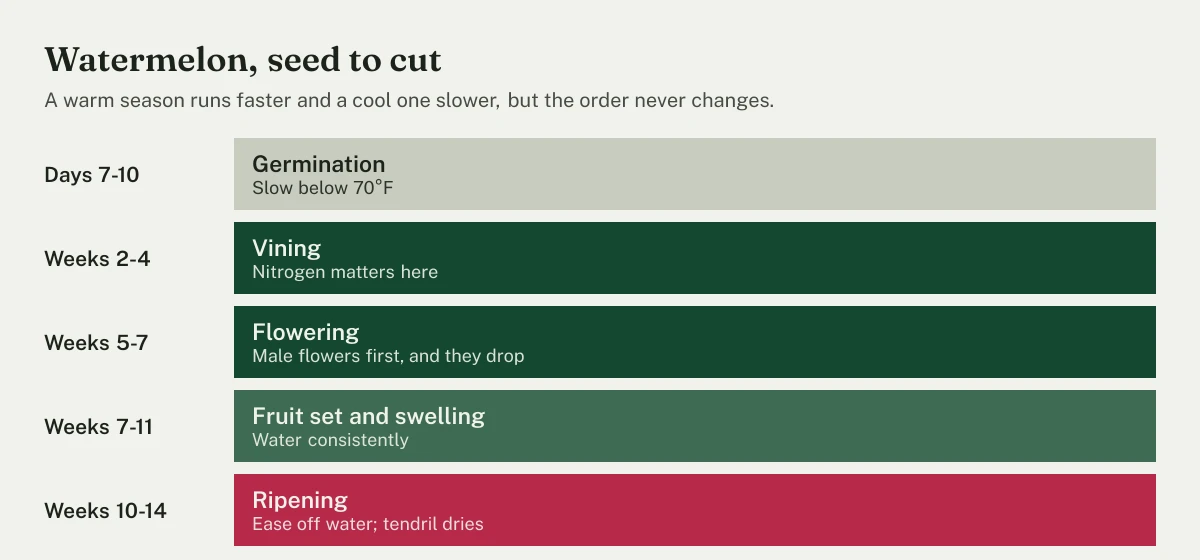
Watermelon growing stages
Knowing which stage a plant is in tells you what it needs, and stops the commonest mistakes — feeding nitrogen during fruit set, or panicking at male flowers that drop.
Germination, days 7 to 10. Seed sprouts in warm soil, slower and less reliably below 70°F. Two seed leaves appear first, then the first true leaf.
Vining, weeks 2 to 4. The plant switches from a compact seedling to running vines. This is the nitrogen-hungry phase, and the point at which the space you allowed becomes obvious.
Flowering, weeks 5 to 7. Male flowers appear first, often a week or more before any female flowers, and they fall off. This is normal and alarms people every year. Female flowers are identifiable by the tiny immature melon at the base of the bloom.
Fruit set and swelling, weeks 7 to 11. Pollinated females begin to swell. This is when water matters most, and when the nitrogen emphasis should already have shifted.
Ripening, weeks 10 to 14. The fruit stops growing and starts converting starch to sugar. Reduce watering here — heavy watering late dilutes flavour and splits fruit.
Watermelon companion plants
Good neighbours, and why.
Corn is the traditional pairing and works on structure: tall corn gives light shade and some wind protection to a sprawling vine, and the two occupy different vertical layers. Radishes are sown between hills and harvested long before the vines need the space, which is a use of time rather than a chemical effect.
Nasturtiums and marigolds earn their place mainly by flowering. Watermelon depends entirely on insect pollination — a female flower that is not visited drops — so anything that reliably draws bees increases fruit set. That is a real mechanism, and a better reason to plant them than the pest-repelling claims usually given. The marigold page sets out what is and is not supported there.
Bad neighbours, and why.
Potatoes. They need digging, and a watermelon vine sprawling across the bed makes that impossible without damage. They also share susceptibility to some soil-borne problems.
Other sprawling vines — squash, pumpkins, cucumbers in quantity — compete for exactly the same ground rather than for nutrients. Two crops running across the same surface smother each other.
Spacing
36 inches between plants, 84 inches between rows.
That is a lot of ground for one plant, and it is not negotiable for full-size varieties — the vines run several feet in every direction. A single watermelon plant can occupy the space of a small bed.
In a small garden, grow them vertically. A sturdy trellis with a fabric sling under each developing fruit works well and is the standard answer where ground space is short. Use a smaller-fruited variety if you do.
The plant spacing calculator will tell you how many a bed takes, and the garden yield estimator gives a realistic harvest range.
When to plant
About 2 weeks after your last frost, and only once the soil is genuinely warm — above about 65°F. Watermelon is among the most heat-demanding crops in the garden and a cold check stalls it permanently rather than temporarily.
Direct sowing is simplest where the season is long enough. Where it is short, start indoors about 3 weeks before planting out — no earlier, because melons resent root disturbance and a pot-bound seedling transplants badly. Use biodegradable pots that go into the ground whole.
Black plastic over the bed for a fortnight before planting warms the soil measurably and is worth doing in cooler regions. The planting date calculator gives the frost-relative date.
Growing in containers
Only with the right variety. Choose an icebox or bush type bred for small spaces, and allow at least 15 to 20 gallons of container per plant.
A trellis with slings is close to essential, since the pot cannot supply ground for the vines to run across. Expect a couple of small melons rather than a crop. Full-size varieties in containers almost always disappoint.
Watering and feeding
Water deeply and consistently — about an inch a week, more during fruit swelling. Irregular watering at that stage causes splitting and blossom end rot.
Then ease off as the fruit ripens. Heavy watering in the last fortnight dilutes sugar and splits fruit. This is one of the few crops where deliberately reducing water improves the harvest.
Shift the feeding emphasis at flowering. Nitrogen through the vining stage builds the plant; continuing it through flowering gives magnificent foliage and few melons. Move towards phosphorus and potassium once flowers appear. How to add nitrogen to soil covers the sources and their release rates if you are feeding organically.
How to tell when a watermelon is ripe
The hardest question on the crop, and the tap test alone is not reliable.
Use three signs together. The curly tendril nearest the fruit's stem dries and turns brown — this is the most reliable single indicator. The ground spot, where the melon rests on the soil, turns from white to a creamy or buttery yellow. And the skin loses its gloss, going from shiny to dull and slightly rough.
Watermelons do not ripen after cutting. Unlike a tomato, what you cut is what you get, so the cost of cutting early is a poor melon and the cost of waiting is usually nothing.
Cut the stem with a knife rather than pulling, leaving an inch or two attached.
Common problems
Flowers dropping with no fruit. Male flowers naturally fall, and they come first. If female flowers are also dropping, it is poor pollination — hand-pollinate with a brush on a dry morning, or plant more flowers nearby.
Huge vines, no melons. Too much nitrogen continued past flowering.
Split fruit. Irregular watering, usually a heavy soaking after a dry spell.
Hard to judge ripeness. Covered above — learn the tendril sign, which is the most reliable.
Watermelons grow well beside sweet corn and should be kept clear of potatoes.